Geumneung or Gwakji Beach: which Jeju shore wins for you
Published 2026-09-07. Conditions described are typical and never guaranteed.
Here is the short answer before you read another line. If you want the biggest, brightest, calmest white sand swim on Jeju's west coast, and you are happy to base yourself out near Hallim, go to Geumneung Beach. If you want a swim with a genuine talking point, a cold freshwater rinse rising up through the sand, and the Aewol cafe coast within reach of Jeju City, go to Gwakji Gwamul Beach. Both are free public beaches with turquoise shallows and July to August lifeguard cover, so neither is a mistake. The right pick turns on what you value most: room and view, or novelty and location.
The quick verdict, reader by reader
Families with small children who prize the gentlest possible wade lean toward Geumneung. Its shallow flats run a long way out, and there is usually more clean sand to spread across because so many visitors stop at the famous bay next door instead. Couples and curious travellers who like a beach with a story lean toward Gwakji, where the Yongcheonsu spring baths give you something no other Jeju beach quite offers.
Travellers on a short stay near Jeju City tend to win with Gwakji, since it is one of the closer good west coast beaches to the airport at roughly forty minutes by car. People building a whole day around the sand, the sunset and the wider Hallim area do better at Geumneung, which sits beside Hallim Park and its own long neighbouring bay. Sunset chasers can pick either, because both face west, though they get there differently. More on that below.
Sand and setting: space versus character
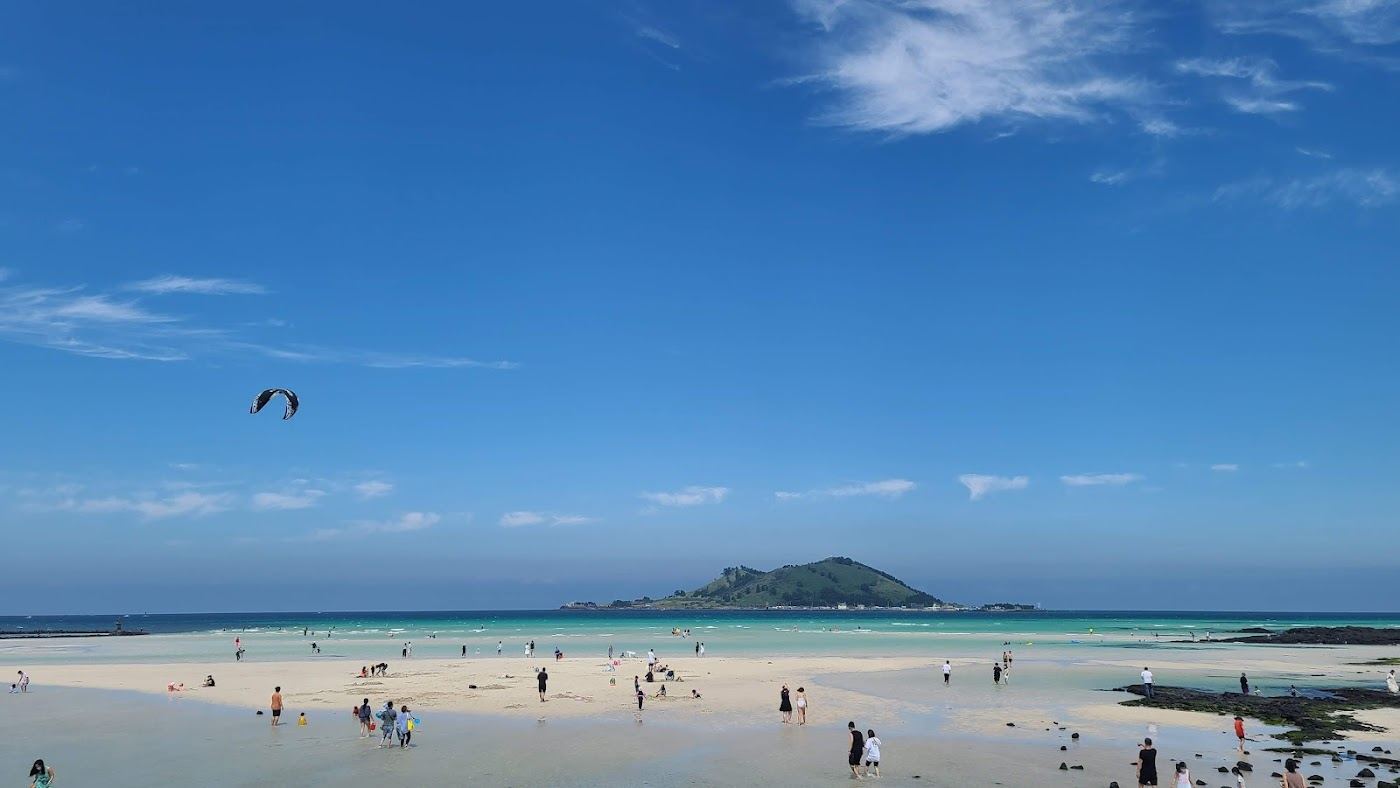
Geumneung is the bright white shell sand of the west coast, soft underfoot and dazzling against the turquoise in strong sun. It opens as a generous bay running alongside its more famous neighbour, and the crucial detail is space: fewer people make the short step across, so there is normally more open sand to choose from. If your idea of a good beach day includes room to breathe and a wide horizon out to Biyangdo island, this is the stronger canvas.
Gwakji is white sand too, running roughly three hundred and fifty metres along the Aewol shore, bright against the basalt and the turquoise. It is a comfortable, well used bay with an open feel rather than a vast strip, and its defining feature is not the size but the freshwater that wells up through it. That spring gives Gwakji a character no length of sand can match. So the sand contest splits cleanly: Geumneung wins on scale and elbow room, Gwakji wins on the thing you will remember and describe to friends later.
The water and the swim
This is where the two beaches feel most alike and yet reward different swimmers. Geumneung's water is clear, turquoise and very shallow well out from shore, one of the gentlest and warmest feeling swims on the island in season and a reassuring wade for children. The west coast is calmer than the windward east, though conditions still vary with the weather and are only ever typical, never guaranteed. There are rocky patches to mind underfoot, as there are along much of this coast.
Gwakji's water is also clear and turquoise, with an average depth of around a metre and a half, shallow and easy for a swim or a wade through the summer. It shares the calmer west coast character and the same caveats about rocky patches and shifting conditions. The practical difference is depth profile: Geumneung stays shallow for longer, which is why the very youngest paddlers edge it there. Gwakji is perfectly gentle, but if a reassuring, barely rising shallow is your single biggest priority, Geumneung has the edge.
Neither beach comes with a swimming safety promise. Lifeguards are posted only during the official season through July and August, when the swim zone is marked. Outside those months there is no cover and the water runs cool to cold.
Facilities and crowds
Both beaches keep things simple in the Korean public way: open access, no gate, no admission to the sand, and seasonal stalls renting parasols, mats and tubes at rates set on the day and to be confirmed. Both have showers, changing rooms and toilets in season, and both sit near cafes and shops.
Geumneung has a campground behind part of the bay and a scattering of cafes nearby, with the larger spread of venues a short walk along the shore at the busier neighbouring beach. It feels comfortable and family friendly without the bustle of the headline bays. Its signature facility, if you can call it that, is simply the space, and easier parking than the crowded bay next door, though both fill in summer.
Gwakji's headline facility is the Yongcheonsu spring baths: cold freshwater rising through the sand and enclosed by stone walls, used for generations to rinse off the salt after a swim. They are free to use and are the real reason to choose this beach over a bigger one. Around them you get the usual showers and changing rooms, plus cafes and the wider Aewol cafe coast a short drive away. Parking behind the bay fills on fine summer days, so an earlier arrival helps here too.
On crowds, both are quieter than Jeju's most famous beaches, but for different reasons. Geumneung is quiet because visitors pause at its celebrated twin instead of walking a little further. Gwakji is busier in feel because it is close to the city and draws the Aewol day trippers, yet its character absorbs them. If solitude on the sand is the goal, Geumneung usually delivers more of it.
When the other one wins
The answer flips more often than a straight ranking would suggest, so here are the situations that should change your mind.
- You are staying near Jeju City on a short trip. Gwakji wins. It is closer, and it pairs neatly with the Aewol cafes for a half day that does not eat your whole schedule.
- You want the cold spring rinse as the centrepiece. Gwakji, clearly, and check the tide first: the spring rises best around low tide, so time your visit if the baths are the plan.
- You are travelling with very young children who want the shallowest wade. Geumneung, for those long turquoise flats that stay gentle far out from shore.
- You want the most open sand and the least crowded stretch. Geumneung, because the crowds concentrate on its famous neighbour.
- You are basing yourself around Hallim and Hallim Park. Geumneung sits right there, so it is the natural anchor for a full west coast day.
Sunset deserves its own note, because both beaches earn it. Geumneung's west coast sunset behind Biyangdo island is one of the finest on Jeju, and it sees far fewer people than the headline beaches, so a stay on the sand into the evening is quiet and lovely. Gwakji's sunset is the west coast light too, with the added ritual of a spring bath rinse before you drive the short way to the Aewol cafes. Choose Geumneung for the framed island silhouette, Gwakji for the sunset plus supper coast combination.
Timing and getting there
Both follow the same Jeju rhythm. July and August are the swim months, with late July often the sweet spot once the monsoon breaks. May, June and October are fine for the sand, the walk and the sunset without swimming, and the cold half of the year leaves a scenic but unswimmable bay. If you are still fixing your dates, the seasonal timing notes for the island are worth a look, and families comparing several bays can browse the family friendly beach roundup before committing.
For access, Gwakji is roughly forty minutes by car west of Jeju City along the coast, one of the closer good west coast beaches to the city, with the blue intercity west coast bus stopping near Aewol. Geumneung is around fifty minutes west in Hallim, beside Hallim Park, with the same blue bus line stopping near the village a short walk along the shore. Parking at both fills on fine summer days, so arrive early either way.
If you cannot decide between the calm neighbour and the busy one it sits beside, our companion piece on Geumneung against Gimnyeong Seongsegi covers a different west versus northeast question that some readers weigh at the same time.
Planning a club day on Jeju
Both beaches here are free public sand rather than private clubs, so there is no gate to book and no admission to arrange. If you would rather add a structured beach club day to your Jeju trip, with loungers and service secured in advance, tell us your dates and party size through the Jeju beach club page and we will help you enquire. It is the simplest way to pair the honest, uncrowded charm of a bay like Geumneung or Gwakji with a booked comfort day elsewhere on the island.